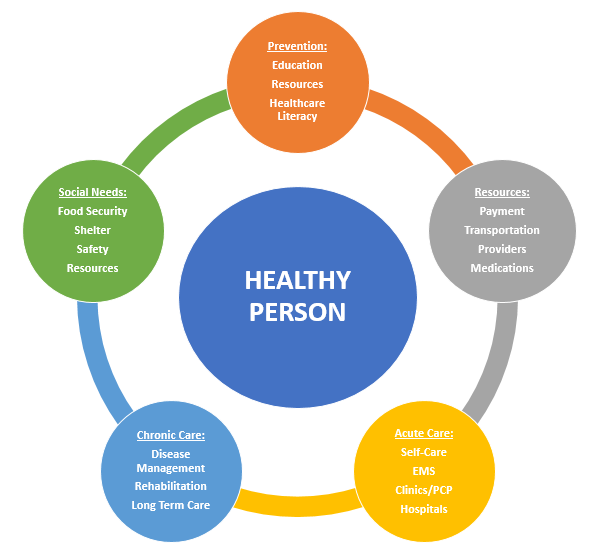
“The social determinants of health are the conditions in which people are born, grow, live, work and age…shaped by the distribution of money, power and resources at global, national and local levels “ (WHO). They are “the complex, integrated, and overlapping social structures and economic systems that are responsible for most health inequities” and health inequity is “the difference or disparity in health outcomes that is systematic, avoidable, and unjust” (CDC).
The social determinants of health include: Income and social status, Employment and working conditions, Education and literacy, Childhood experiences, Physical environments, Social supports and coping skills, Healthy behaviors, Access to health services, Biology and genetic endowment, Gender, and Culture (Canada).
Years ago, already a paramedic, I went back to school to get my nursing degree. One of my favorite classes was on Cultural Competency. The curriculum covered the importance of understanding your patient as a complete being and recognizing how each aspect of their person had an impact on their health.
Humans are not made of molds. The complexity of our lives results in diversity, even between twins. We are a product of our complete existence and to properly understand and address health concerns, one must consider this. A couple examples…
Many people do not fill prescriptions. This is due to a variety of reasons: limited understanding of the need and purpose, limitations in insurance coverage or ability to pay, limitations in transportation resources to go to the pharmacy. Due to cost, sometimes patients are left to choose between food or housing and prescription medications. Simply prescribing medications, while it may be what the patient ultimately needs to address their ailments or manage their disease, is ineffective if their housing and food insecurities are not addressed.
Different cultures eat differently. Managing diabetes requires the patient to be informed and deliberate about their food choices. Most of the educational materials I have seen are not culturally sensitive, meaning they are not specific to the patient or their culture and therefore fail to provide realistic and applicable information regarding which foods to avoid and which to consume more frequently for improved health outcomes.
What does this have to do with Fire/EMS? Fire/EMS and their first responder employees have a unique experience and understanding of their communities due the nature of their business, responding to those in need. With that experience, and associated information, comes responsibility. We are stewards of the people we serve. We are the safety net of society. We must leverage our data to address gaps in services and then use it to make a difference in patient outcomes either through programming and/or advocacy.
Compassionate care. Informed practice. Patience with patients. Outcome focused programming. Advocacy for change. How do the social determinants of health impact your care?
 Sarah J McCrea-Dameron