Broken Leadership

https://www.asaecenter.org/association-careerhq/career/articles/career-management/how-to-rebuild-broken-trust-in-leadership

I wholeheartedly believe in the purpose of unions and am grateful for the safety and security they provide for their members, regardless of industry. I was a member of a union for many years and benefited from their work and advocacy in policy, procedures, benefits, and contracts. Now I find myself on the “other side” and learning a great deal about the “behind the scenes” politics and relationships.

I consider myself an optimistic realist and wear that badge proudly. I focus on the facts and then work towards the best possible outcome for most, do the most we can for the most at hand. It is impossible to make everybody happy all of the time. There will always be somebody that is not happy with your decision, somebody that feels they are not getting what they want or feels they had to sacrifice too much. It’s an unfortunate reality.

Administrative leadership in local government with union employees is complicated. First and foremost, you serve your community, the people that pay taxes and depend on your operations to meet their needs, the purpose for your existence. You also serve your elected officials placed by your community members to be advocates and stewards of their funds and priorities. Equally as important, you serve your employees, those that actually get the work done. Union leadership, like your elected officials, have been placed by your employees to be advocates and stewards of their funds and priorities. Administration is stuck in the middle, constantly being pulled in at least two directions.

Ideally, the priorities and resources of the elected officials and the people they represent could be those that the union leadership and employees understand and support. Enough resources and funding to get the job done safely and efficiently would be ever-present. This would make the work of administration effortless, simply responsible for the execution of a consensually agreed upon and amply funded strategic plan. Easy (I think, I’m not sure it’s ever happened).

The hard part is working between these two parties when they don’t align. The strategic plan of the elected officials has unfunded expectations and union leadership pushes back to protect the interests of their members. Sometimes, I feel like what I assume a marriage and family therapist might feel like when the parents in a broken home cannot get along and put the children in the middle. The children are given half-truths and biased versions of the truth, start to lose trust in one or both of their parents. The focus shifts from feeling blessed for what they have to lamenting what they have-not. The parents focus more on bickering and arguing than on co-parenting, and lose the focus of putting the children first. Like a broken home, it feels like broken leadership.

Here is my optimism, not sure why it can’t be a reality, perhaps it’s my naiveté. I’ll sour with time, I suppose. Why can’t we all just get along…for the benefit of the community and our members? Let’s come together and work this out, keeping our focus on our unified purpose. Let’s start with complete transparency rather than hidden agendas, they are a complete waste of time. Hours of debate seeking compromise, only to be surprised by an ulterior motive or additional information not immediately available. Let’s start with trust and a commitment to co-leading, it’s what the community and the members want and deserve. How do you resolve the feeling of being stuck in the middle? How do you improve the morale of your people when they are working in an environment with broken leadership?

Lawnmower Leadership

I recently attended a new student orientation program at the college that my oldest child will be attending this fall. I was impressed with the event, specifically the portion during which they separated the parents from the students. While the students were touring with breakout groups specific to their majors, they provided parent-specific material and expectations.

Sitting there in the lecture hall with other parents going through a similar experience, many of us sending a child off to college for the first time, I listened to the professor describe what to expect in the coming months. There was a portion of the programming during which they encouraged us to reflect on our parenting styles, the examples provided were helicopter and lawnmower parenting. I had heard of helicopter parenting and was sure I hadn’t parented in that style, but lawnmower parenting? I hadn’t heard of it, and instantly became fearful I might have done just that.

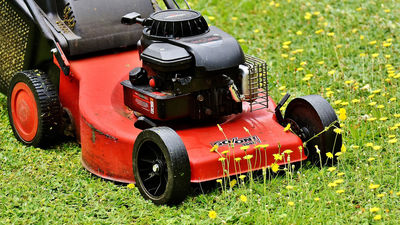
Picture this, there’s a large area with high grass, a parent pushing a lawnmower, a child walking easily behind them in the neatly mowed grass path. The parent is doing all of the work, the child walks carelessly and effortlessly along. In a state of personal reflection, I acknowledge that as a parent and leader, I intentionally remove obstacles and attempt to set my children and subordinates up for success. A fellow team member on the executive staff with a similar leadership style likens himself to a bulldozer, leading his team down the road and removing obstacles along the way. What could possibly be wrong with this style? Isn’t this just advocacy and support? Isn’t that what I’m supposed to be doing?

Apparently not. Apparently, people are supposed to struggle a little. They have to experience hardship and challenges, failures and setbacks. It’s in those moments that they learn how to cope and overcome. They learn about innovation and perseverance. They might fall down, stumble, toss about, but they get up stronger. And most importantly, they learn how to get up and try again. We hear this all of the time, as individuals. Don’t give up! Try again! Believe in yourself! How do we practice this in leadership?

I asked my children if I was in-fact a lawnmower parent and they proceeded to laugh and say no. I pressed them a little, “then what kind of parent am I?”. They thought for a moment and then my son said, “maybe a weed-wacker”. He explained, “you get the big stuff out of the way and we know you are there for us, but you make us do most of it ourselves”. I’ll take that, while also making sure I am giving people ample opportunity to clear their own paths to success and personal growth.

Turn It Down

Throughout most of my adult life, I have been known for my tenacity, brazenness, and passionate advocacy. I have a competitive personality which I have come by honestly after years of competitive sports and being a woman in the fire service. Throughout my career, there hasn’t been a day that has gone by that I didn’t have to prove myself to somebody. Unlike my male counterparts, seniority and rank don’t grant me anything. It doesn’t bother me, it’s just a fact. I have adjusted to the environment by actively attempting to earn the respect of those with which I work. I never back down from a challenge and aim to work as hard or harder than anybody else in the room or on the team.

This perspective requires balance. I don’t need to be better than anybody else. I don’t need to make a fool of anybody else. My goal is to be good enough to earn the trust and respect of my team so they know they can depend on me to do the job. I am also sensitive to the individual needs of my teammates and recognize the importance of their personal confidences. Effective teams work together by building each other up to maximize their strengths and minimize their weaknesses.

During the first few years of my tenure in administration, I was fortunate enough to have a mentor that provided regular feedback. Whether a written report, difficult decision, presentation, or otherwise, I looked forward to his constructive criticism in my continued professional development. One day, after one of our committee meetings during which I did my usual “leaning in” – speaking up, advocating, and articulating, his feedback was a motion of his right hand, index finger and thumb, simulating the turning down of a knob.

Believe me, I know I am imperfect, I have many “spirit breaks”, but this I did not expect. I thought I was in-check, in control, and effectively walking the line of respectful courage. I thought it was what I needed to do in the moment, all moments, and now I was being told to “turn it down”.

Like all constructive criticism should encourage us to do, I reflected on this feedback. I still think about it often. It hasn’t changed who I am or where I come from, but it does give me pause and encourages a greater sense of awareness. It has increased my sensitivity to the room, to my team, and to the way in which I communicate. It has humbled me and empowered me. I have a knob, I have control, and I turn it down, or up, when appropriate.

The Decision of Indecision

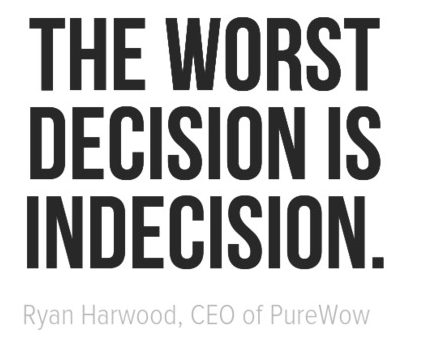
I’ve never really been one for indecisiveness and not because I always know what to do or have the right answer. Instead, my choice to make a decision stems from an understanding that not making a decision is a decision and likely the option I have less control over. I found the following quote from Bill W. that sums it up nicely, “Indecision with the passing of time becomes decision”.

Being decisive is a multifaceted state. You’re faced with a decision. You consider the facts, the outcomes, the consequences. You choose. Life goes on. It has been my experience that opportunities to make decisions never stop coming. They’re not like the items on my Monday To-Do List, whereas once I cross it off it is done, gone, I don’t have to worry about it anymore. Opportunities to make decisions keep coming, and they aren’t going to stop. It takes confidence to make decisions, and making decisions builds confidence. Sometimes, it might even take courage to make a decision.

Some decisions are significant and come with great consequences. They require time and patience: time to work through the problem to find the Simplicity on the Far Side of Complexity, and patience to allow facts to surface and conclusions to formulate. Often though, especially with significant decision-making moments, there will be several smaller decisions to be made after the fact, providing ample opportunity to make subtle corrections if needed or to address certain aspects not directly impacted by the initial decision. Overthinking the situation can lead to Paralysis by Analysis, or indecision.

Yes, making a decision can be scary or worrisome. Nobody likes to be wrong or make bad decisions. But like Maimonides said in his quote, “The risk of a wrong decision is preferable to the terror of indecision”, or Aaron Burr in his, “Error often is to be preferred to indecision”, indecision is even worse than being wrong. Even Berhard Langer agrees, “Be decisive. A wrong decision is generally less disastrous than indecision”.

After all, like John Ortberg said, “Greatness is never achieved through indecision”. Be great, start by making a decision!

Simplicity on the Far Side of Complexity in the Fire Service

https://www.planplusonline.com/simplicity-side-complexity/

“I would give a nickel for simplicity on the near side of complexity, but I would give my life for simplicity on the far side of complexity” – Both Einstein and Oliver Wendell Holmes, Jr. have been credited with some variation of this quote.

In the fire service, it is very applicable. We, without hesitation, trust and follow the incident commander that can effectively manage an emergency with a calm confidence. We breathe easier, no matter the situation, when we hear their voice on the radio. They have earned this respect and following through a demonstration of their skills and competence over time and throughout experiences. It wasn’t the run-of-the-mill-room-and-content fire, or the typical MVA-MCI, it was the this-could-go-south-at-any-moment or walking-the-line-between-offensive-and-defensive calls where they made the right call at the right time, everybody went home safe, there were no fatalities, and all-the-while, they were “cool as a cucumber”.

These leaders respect the incident, respect the risks, respect the unknowns, respect their people…understand them all and their relative complexity due to their dedicated training and discipline…and then make the resolution of the emergency appear as a simple exercise in the basics.

This is simplicity on the far side of complexity, and it’s the only place where simplicity belongs in the fire service.

Seize the moment, it’s the catalyst of your future

Several years ago, one of my mentors wisely said, “every day and every moment is a job interview, you never know who is watching and what they might mean to you now and in the future”. I have often repeated these words to myself throughout the course my life and career, and more times than I can count, they have proven to be true. One time in particular that comes to mind was when I was testifying before a government council on behavioral health, providing both subject matter expertise regarding a policy change they were considering as well as presenting a potential program to better address mental health crisis and associated emergency response. That moment provided one opportunity within weeks and another several years later.

The first opportunity was immediate recruitment to join the working group tasked with getting community paramedicine from concept to bill to state law. After several months, meetings, trips to the state capitol, and more testifying before the legislature, we were successful! Many members of the working group have gone onto other related adventures and projects. Some remain in their previous positions or companies, continuing to be innovative and changing the way we provide care and services to our communities. All of them are influencers and amazing people to know. I am grateful for the lasting relationships the working group involvement afforded me.

The second opportunity was nearly three years after testifying before the government council. A member of the audience remembered the presentation on the program to better address mental health crisis and associated emergency response and wanted to provide state funding to try it. It came as a complete surprise but we were eager to give it a whirl and ultimately, the program is getting even-better-than-expected results! We call it the Crisis Response Team. A public-private partnership with the state, local fire department, private ambulance, and a nonprofit working together to provide an ambulance response with an advanced EMT, paramedic, and licensed clinical social worker to behavioral health crisis calls within the emergency response system.

And so those words of my mentor continue to repeat in my head frequently, even in the most seemingly insignificant of circumstances. Every day, we come in contact with more people than we realize. How do we portray ourselves? What do we communicate to them through our words and actions about our values, purpose, and potential? If we were to treat each project, each conversation, each encounter as if it were an interview for the future job of our dreams, how would that influence our effort and behavior?

Why a Firefighter?

I’m asked on a regular basis, why a firefighter? Honestly, it fell into my lap when I was nineteen on the recommendation of my brother-in-law who was a firefighter/paramedic for a neighboring department. In hindsight, it makes all the sense in the world. At the time, I was playing college soccer, pursuing a degree in pre-medicine, my only work experience had been lifeguarding at Wet ‘n Wild, and I had just finished four years of Student Council in high school. Each of these aspects of my past unknowingly prepared me for success in the fire service, and because of them, I have found a home in public services.  

Soccer: Firefighting is a team sport. There is a captain, roles and assignments, strategies and tactics. We play to the strengths and weaknesses of our teammates. Sometimes we’re on offense, advancing hose lines deep into structures to find the seat of the fire. Sometimes we’re on defense, evacuating compromised buildings with imminent collapse and setting up master streams to prevent the fire from spreading. Each player has a responsibility to the team to maintain fitness and competency. We follow orders because victory depends on it.

Pre-medicine: Ninety percent of LVFR’s calls for service are medical in nature. From cardiac arrests to strokes to heart attacks to trauma, paramedicine is exactly that, “like medicine”. While I was in the fire academy going through the EMT Intermediate curriculum, my sister was in nursing school. Within a few weeks, my cohorts and I were learning how to administer medications intramuscularly and intravenously. My sister had to complete nearly two years of prerequisites and basic human science classes before she was allowed to administer medications using those routes. A few years later while in paramedic school, a nine-month program, I was quickly intubating, delivering electrical therapy, and administering intraosseous medications. I was practicing medicine!

Lifeguarding: While lifeguarding at Wet ‘n Wild, I became CPR and first-aid certified as well as learned several rescue techniques. Over the course of the summer, I made several saves often of children that did not know how to swim yet their negligent parents assumed they were safe to ride the inner tube down the rapids and into the deep, tumultuous waters. We were regularly audited, unexpectedly pulled for an assessment of our skills. Over time, I learned to like audits as they gave me an opportunity to practice my hard-earned skills.

Student Council: Only in the last few years have I come to understand the purpose of my four years of Student Council in high school. On a much smaller and less significant scale, I learned a lot about elections, popularity, budgets, programs, and fundraising. The budget for the Girls’ Reverse Formal was a few thousand and we managed the music, decorations, venue, photography, advertising, and ticket sales. The Nurse Triage Line’s budget is in the hundreds of thousands and we manage the software, recruitment, selection, training, stakeholder engagement, data analytics, and sustainability.

I suppose, it was meant to be.