Courage in Innovation

We have a new program in our fire service, the Nurse Call Line. The Nurse Call Line exists to better navigate our community through the health and social service agencies of our community.

Without it, when people call 9-1-1, they are dispatched an ambulance, or more, maybe a fire truck or engine, depending on their complaints. Upon arrival, the EMS providers are straddled with two options: one, transport the caller to the hospital by ambulance; or two, the caller refuses medical treatment and transport. There is currently no in-between.

With the Nurse Call Line, we are able to connect 9-1-1 callers that have low acuity complaints directly with an emergency-medicine-experienced, registered nurse that utilizes a set of evidence-based, time-tested protocols and determines alternate care plans such as self-care, self-transport, the dispatching of emergent or non-emergent EMS resources, or maybe even a ride-sharing service.

Every time the Nurse Call Line doesn’t send an EMS resource, they save the callers, the insurance companies, and the community hundreds of dollars by reducing unnecessary EMS transports to the hospital. Every time the Nurse Call Line is able to address the needs of the caller without transportation to a health care facility and instead manages the needs of the caller through referrals to alternative resources or provides them with information for self-care, they save even hundreds more in prevented urgent care and/or emergency department costs.

Bottom line, the Nurse Call Line saves money and aligns callers with the most appropriate care for their needs.

We started the Nurse Call Line two years ago as a pilot program, wishing to evaluate the results before committing to permanent staff and funding. Two years ago, we recruited a team of nurses that were highly skilled and experienced in emergency medicine. We shared with them our dream, the intent of the program, the molds we were going to break, the uncertainty of the program’s future and invited them to join us on the journey. Each nurse that was offered the position accepted, despite this uncertainty and lack of sustainability. Each of the nurses that joined our team knew exactly what we were trying to accomplish, because they, as emergency medical nurses, had been experiencing the same frustrations we had. They also understood that the system was broken and that this new way of connecting with patients had great potential.

Hundreds of years ago, when captains recruited crew members for sailing exhibitions, they promised gold and riches, freedom and glory. This is what inspired men to travel into the great unknown, for near-certain death. Countless brave and courageous men lay at the bottom of the ocean, having lost the battle somewhere at sea and hundreds of miles from their intended shore and land of opportunity. Our nurses have that courage.

Like all new programs, there are many unknowns. Like all new programs, we deliberated about the details and pontificated over the possibilities, but at some point, we had to launch. We expected much learning along the way, discovery in the journey, and we knew we would never reach our final destination as there will always be more opportunity or room for growth and expansion.

The Nurse Call Line was no different. We made many mistakes, especially along the lines of training both new and incumbent staff. We could have done better, especially as it pertained to existing employee buy-in and engagement. We did our best at the time, especially when it came to the IT programming and interface…we were building a plane in-flight and these were unchartered lands.

Fortunately, we had a great crew. They knew where we were heading and what we were trying to accomplish. They forgave and instead supported the weaknesses of their leaders, while displaying courage and commitment in the face of opposition and uncertainty. And while we have not crossed the finish line, we have made progress and have confidence we are heading in the right direction.

It takes courage to be innovative. I am grateful for the courage the nurses of our pilot program have demonstrated over these past two years! Their bleeding hearts of compassion are those of warriors.
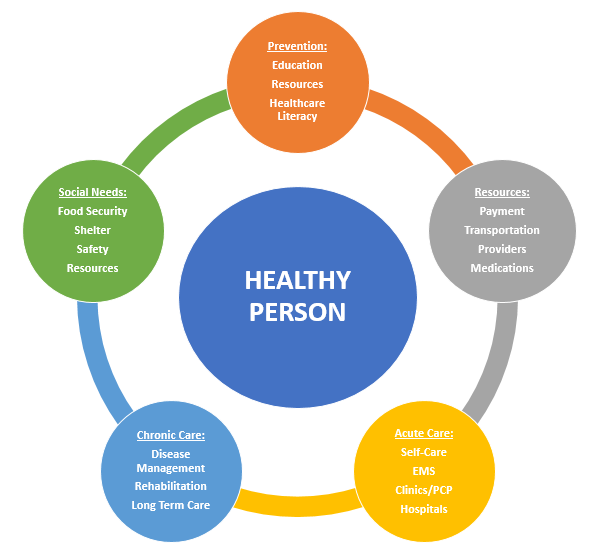
What are the Social Determinants of Health and what do they have to do with Fire/EMS?

“The social determinants of health are the conditions in which people are born, grow, live, work and age…shaped by the distribution of money, power and resources at global, national and local levels “ (WHO). They are “the complex, integrated, and overlapping social structures and economic systems that are responsible for most health inequities” and health inequity is “the difference or disparity in health outcomes that is systematic, avoidable, and unjust” (CDC).

The social determinants of health include: Income and social status, Employment and working conditions, Education and literacy, Childhood experiences, Physical environments, Social supports and coping skills, Healthy behaviors, Access to health services, Biology and genetic endowment, Gender, and Culture (Canada).

Years ago, already a paramedic, I went back to school to get my nursing degree. One of my favorite classes was on Cultural Competency. The curriculum covered the importance of understanding your patient as a complete being and recognizing how each aspect of their person had an impact on their health.

Humans are not made of molds. The complexity of our lives results in diversity, even between twins. We are a product of our complete existence and to properly understand and address health concerns, one must consider this. A couple examples…

Many people do not fill prescriptions. This is due to a variety of reasons: limited understanding of the need and purpose, limitations in insurance coverage or ability to pay, limitations in transportation resources to go to the pharmacy. Due to cost, sometimes patients are left to choose between food or housing and prescription medications. Simply prescribing medications, while it may be what the patient ultimately needs to address their ailments or manage their disease, is ineffective if their housing and food insecurities are not addressed.  

Different cultures eat differently. Managing diabetes requires the patient to be informed and deliberate about their food choices. Most of the educational materials I have seen are not culturally sensitive, meaning they are not specific to the patient or their culture and therefore fail to provide realistic and applicable information regarding which foods to avoid and which to consume more frequently for improved health outcomes.

What does this have to do with Fire/EMS? Fire/EMS and their first responder employees have a unique experience and understanding of their communities due the nature of their business, responding to those in need. With that experience, and associated information, comes responsibility. We are stewards of the people we serve. We are the safety net of society. We must leverage our data to address gaps in services and then use it to make a difference in patient outcomes either through programming and/or advocacy.

Compassionate care. Informed practice. Patience with patients. Outcome focused programming. Advocacy for change. How do the social determinants of health impact your care?

Healthcare, right or privilege?

I know, this can be a touchy subject and I am not going to pretend to have the answer, but I believe it is important that we have this conversation as we work through the issues currently facing healthcare in the United States. I also am not going to pretend to be an expert, certainly not on healthcare entirely, but I do have some experience, especially in emergency medical services.

Most people are unaware and uninformed of the experiences of emergency medical services providers. Most assume they are filled with cardiac arrests, severe respiratory distress, critical trauma, heart attacks, strokes, and other “true” emergencies and while this is partially correct, would it surprise you to learn that a significant portion of 911 calls for service are not necessarily “true” emergencies, but instead people that lack resources such as housing, food, transportation, prescription refill, behavioral health, or primary care? People routinely utilize the 911 system for: a hot meal and a bed for the night; the ambulance ride to the hospital because they don’t have their own car, a family member or friend that can take them, or money for a cab or public transit; prescription refill because they have run out of their medication and they can’t get into their primary care physician (if they even have one) for several weeks; and, their limited behavioral health benefits have run out (if they had them at all). Sometimes, they call 911 because they assume if they arrive by ambulance, they won’t have to wait in the emergency department waiting room.

I bring this up in the context of the question of healthcare being a right or privilege because from an emergency medical services perspective, due to EMTALA (and basic principles of humanity), access to emergency healthcare is a right. Emergency medical providers must treat all who call upon their services without prejudice, whether or not they are insured or have the ability to pay. In most communities, EMS protocols don’t allow them to transport the patient anywhere but the hospital and they seldom, if ever, permit EMTs and paramedics to treat and release. This means that most people that call 911, whether they are having an emergency or not, whether they can pay or not, are going to the hospital by ambulance.

What we know about healthcare is that emergency is the most expensive form of services. Primary and preventative care is significantly less expensive and if used, greatly improves health outcomes and thereby reduces morbidity and complications. If we treat services such as primary care, preventative care, dental care, behavioral health, eye care, pain management, nutrition, chronic disease management, and programs that address the social determinants of health as a privilege, we all pay for the over-utilization of emergency medical services for two reasons. One, people will be sicker because they don’t have access to primary and preventative care thereby utilizing emergency services in their place or waiting until they are so sick, they actually experience an emergency. Two, all services will be more expensive because somebody has to pay the bill. Nothing is free.

The cost of doing nothing is exorbitant. Untreated behavioral health results in greater crime rates, jail and law enforcement costs, increases in drug and alcohol abuse, homelessness, and more. Not addressing social determinants of health such as housing, food, transportation, nutrition, and education results in poorer health, an increase in medical costs, lost productivity, and more. Not only is refusing access to quality human services due to a lack of ability to pay inhumane, it is fiscally irresponsible. What are your thoughts? If it isn’t a right and it is a privilege, when do we say “no” and how?

Mobile Integrated Healthcare (MIH) in the Fire Service

In one of my previous blogs, I talk about how the fire service has done an excellent job of reducing the number of fires in their communities through the efforts of their fire investigators, inspectors, and prevention personnel and programming; collectively called, Fire Prevention. Considering that 90% or more of the calls for service each year for most fire agencies are not fire in nature, but instead a combination of emergency medical and public assist calls, isn’t it time we establish something like an Emergency Medical Services (EMS) Prevention Division? Humor me and read on:

EMS Investigations: a team of highly-trained, specifically-certified people dedicated to investigating why a particular person or facility or neighborhood is having a particular set of problems such as: respiratory illness, frequent falling, medication errors, transportation barriers, lack of housing or food security. This team compiles their information into a meaningful report and passes the information onto the rest of the team for further action. If there are facilities that are mistreating their patients, or people that are committing elderly abuse, or if there are barriers to accessing primary care or housing or food or transportation, these issues would be well documented, empowering effective advocacy and accountability through the various channels for correction.

EMS Prevention: a team of highly-trained, specifically-certified people dedicated to preventing illness and injury in our communities armed with data from first response documentation and the EMS Investigations reports. They would provide targeted education and training to the community, such as: how to prevent diabetes, heart disease, strokes, drownings, falls, vehicle accidents, and more. Rather than fire exit drills they would be providing healthy diet, exercise, and rest modules. Rather than teaching CPR at local pools, they would be mandating and facilitating the installation of pool gates and safety alarms to prevent drowning in the first place. They would be testifying before the legislature regarding unsafe practices in nursing homes and assisted living facilities, ensuring patients receive the care and attention they deserve. They would advocate for a more comprehensive public transportation model that didn’t require 2-hours and 8 bus changes to get somebody to their job, each way. They would advocate for affordable housing and against food deserts and lack of primary care.

EMS Inspectors: a team of highly-trained, specifically-certified people dedicated to ensuring neighborhoods, apartment complexes, medical facilities, nursing homes, assisted living facilities, and schools are following the best practices identified through the EMS Investigations findings…that people are safe from medication errors, fall risks, and healthcare and social service practices more interested in profits than patient outcomes. Just as Fire Inspectors have the authority to assess fines and close unsafe buildings, EMS Inspectors could be so empowered.

This is Mobile Integrated Healthcare (MIH) in Fire Services. MIH is simply using patient-centered, mobile resources in the out-of-hospital setting for improved community outcomes. The Fire Service is well-positioned to provide these services for three main reasons: 1. publicly funded services have an obligation to do the right thing regardless of reimbursement or financial profits; 2. preventing illness and injury in the community is the right thing to do; 3. if you do nothing, it’s only going to get worse and our current models can’t support that.

What are your thoughts about an EMS Prevention Division a.k.a. Mobile Integrated Healthcare in the Fire Service? Leave your comments below: