The Golden Ticket

A few members of my team and I just finished a week of interviews for the position of firefighter trainee. We are looking for more than thirty people to join our fire family for the next 25 to 30 years. Who do we hire? These are big decisions not only for our department but also for the candidates seeking the position. In the 50+ people we interviewed this week, I met the future Fire Chief. I also met their Senior Deputy, another Deputy Chief or two, certainly a few Battalion Chiefs, several Captains, an EMS Educator, two or three Fire Training Officers, and lots of Engineers and Paramedics. I could see their future in our organization while they spoke of what they have done to prepare for the job of Firefighter Trainee and why they want to join the service.

Selfishly, it brought me great hope for the immediate, mid- and long-range futures of our organization. It’s easy to get caught up in the drama of the day, whether external or internal politics and drama. My days blur with shifting priorities, internal and external customer needs, striving for excellence, strategic planning, lack of funding, chasing accreditation, and personnel management. It can be challenging to find victories and moments of celebration amongst all the still-have-to’s and why’d-you-do-it-that-way’s. I had the privilege of spending over thirty hours listening to one ambitious and driven candidate after another. I had the privilege of listening to their stories, to their lessons learned along their quest for the position of firefighter trainee with our organization. I had the privilege of learning about our organization through the young-hopeful’s of our community, and it was inspirational, giving me the boost I needed to keep plugging away and getting work done. When I was on the streets, I found purpose on each and every call. I saw the relief in my patient’s eyes when I walked in the door and I slept soundly knowing I made a difference.

Unselfishly, I know the value of the offer they seek from us, to be a firefighter trainee. Getting onto the fire department is the metaphorical equivalent to the Golden Ticket from Willy Wonka, it’s the opportunity of a lifetime and has the potential to change a person’s life forever, perhaps for generations to come. The fire service has given me all that I have. Throughout my time in the service, my organization has provided me with the benefits, opportunities, and sustenance to raise my children, obtain college degrees, gain one certification after another, promote, travel, and live a life of fulfillment both in salary and purpose. I have acquired a second family and made life-long friends. If that isn’t the Golden Ticket, I don’t know what is. I am eternally grateful for my Golden Ticket, and like Willy Wonka, will carefully select those that will care for my organization after my last days because I love this place, Oompa Loompas and all.

Choose the Hard Way to Breathe Easy

Let’s face it, life is hard…if you’re living it right. The Austrian poet and novelist Rainer Maria Rilke said, “The easy path leads to the hard life, but the hard path leads to the easy life”. This has been my experience, most certainly. Seldom, if ever, has greatness come from any easy decision or easy chore in my life. Those things that mean the most to me and that have proven to be the most rewarding have taken great sacrifice and perseverance to achieve.

For example, getting into the fire service is no easy task but worth every minute of effort, I promise. Many fire departments are seeking candidates that have their EMT certification and fire science degrees. Better yet are the candidates that have survived a firefighter academy and have experience in first response either as an EMT or volunteer/wildland firefighter. This means that many of our candidates have already dedicated years of their lives to becoming a firefighter, in the hopes of being given the chance to go through our fire academy. It’s still no guarantee, but it’ll be worth it in the end.

The fire academy is no easy task, but worth every ounce of the blood, sweat, and tears sure to be lost during the experience. Ours is a twenty-two-week academy during which the recruit earns their state firefighter, hazardous material awareness, and advanced EMT certifications. They also learn about our values and culture, our strategies and tactics, and prove themselves time and again both mentally and physically. Twenty-two weeks of grueling tests and evaluations with the lingering and impending thought of potential failure and termination at every turn. It’s tough, but it’ll be worth it in the end.

Being a firefighter is no easy task, but worth every holiday away from family, every lost night of sleep, every sore back and stiff knee, every life lost for the chance to save another. It’s a career with purpose and honor, comradery and teamwork. It’s not easy to not only experience death and destruction, but to also be expected to stop the loss, save all viable life, and prevent any further injury or damage from happening, all within minutes. Firefighters are professional problem solvers and the pressure to always know what to do in every situation is enormous, especially because so much usually at stake. But it’s worth it in the end.

Being an administrator of a fire service agency is harder than I ever imagined it would be. As a firefighter, my focus was on the community and my crew. As an administrator, it is the community and the entire department, all divisions. With limited funding, aged resources, and political tensions, most days are littered with “no’s” and “not right now’s”, which are far better than the “never’s” and “what are you thinking’s”. It brings me great joy to know that my job is to serve the community through the hands and hearts of firefighters. Through it all, even though it has only gotten harder, it’s worth it.

The hard path has made my life easy, filled with purpose, pride, family, and security. And for that I am grateful, as I breathe easy.

Courage in Innovation

We have a new program in our fire service, the Nurse Call Line. The Nurse Call Line exists to better navigate our community through the health and social service agencies of our community.

Without it, when people call 9-1-1, they are dispatched an ambulance, or more, maybe a fire truck or engine, depending on their complaints. Upon arrival, the EMS providers are straddled with two options: one, transport the caller to the hospital by ambulance; or two, the caller refuses medical treatment and transport. There is currently no in-between.

With the Nurse Call Line, we are able to connect 9-1-1 callers that have low acuity complaints directly with an emergency-medicine-experienced, registered nurse that utilizes a set of evidence-based, time-tested protocols and determines alternate care plans such as self-care, self-transport, the dispatching of emergent or non-emergent EMS resources, or maybe even a ride-sharing service.

Every time the Nurse Call Line doesn’t send an EMS resource, they save the callers, the insurance companies, and the community hundreds of dollars by reducing unnecessary EMS transports to the hospital. Every time the Nurse Call Line is able to address the needs of the caller without transportation to a health care facility and instead manages the needs of the caller through referrals to alternative resources or provides them with information for self-care, they save even hundreds more in prevented urgent care and/or emergency department costs.

Bottom line, the Nurse Call Line saves money and aligns callers with the most appropriate care for their needs.

We started the Nurse Call Line two years ago as a pilot program, wishing to evaluate the results before committing to permanent staff and funding. Two years ago, we recruited a team of nurses that were highly skilled and experienced in emergency medicine. We shared with them our dream, the intent of the program, the molds we were going to break, the uncertainty of the program’s future and invited them to join us on the journey. Each nurse that was offered the position accepted, despite this uncertainty and lack of sustainability. Each of the nurses that joined our team knew exactly what we were trying to accomplish, because they, as emergency medical nurses, had been experiencing the same frustrations we had. They also understood that the system was broken and that this new way of connecting with patients had great potential.

Hundreds of years ago, when captains recruited crew members for sailing exhibitions, they promised gold and riches, freedom and glory. This is what inspired men to travel into the great unknown, for near-certain death. Countless brave and courageous men lay at the bottom of the ocean, having lost the battle somewhere at sea and hundreds of miles from their intended shore and land of opportunity. Our nurses have that courage.

Like all new programs, there are many unknowns. Like all new programs, we deliberated about the details and pontificated over the possibilities, but at some point, we had to launch. We expected much learning along the way, discovery in the journey, and we knew we would never reach our final destination as there will always be more opportunity or room for growth and expansion.

The Nurse Call Line was no different. We made many mistakes, especially along the lines of training both new and incumbent staff. We could have done better, especially as it pertained to existing employee buy-in and engagement. We did our best at the time, especially when it came to the IT programming and interface…we were building a plane in-flight and these were unchartered lands.

Fortunately, we had a great crew. They knew where we were heading and what we were trying to accomplish. They forgave and instead supported the weaknesses of their leaders, while displaying courage and commitment in the face of opposition and uncertainty. And while we have not crossed the finish line, we have made progress and have confidence we are heading in the right direction.

It takes courage to be innovative. I am grateful for the courage the nurses of our pilot program have demonstrated over these past two years! Their bleeding hearts of compassion are those of warriors.

9-1-1 Dispatchers, the HEROES you don’t see

I’ve been in the fire service for over twenty years. A little over 6 years ago, I moved into an administrative role and started learning more about the various divisions of the department, other than Operations or Suppression, including but not limited to: Training, Administration, Logistics, Prevention, and Fire Communications. My first assignment was the Emergency Medical Services Quality Improvement Coordinator (EMS QIC). In this role, one of the many tasks and responsibilities included investigating customer/patient complaints or incident concerns and would involve reviewing the incident from time of 9-1-1 call through to final patient care disposition.

All those years in the field, I communicated with dispatchers on the daily. I would listen intently to their incident dispatch, where they provided essential information I needed to ensure I knew where I was going and what I was going to encounter. They were there for me when I needed to request additional resources, or help getting more information from the 9-1-1 caller, or provide telemetry to the receiving hospital. They were not only my lifeline if I ever needed help, but also the neural network that made the whole system work.

But it wasn’t until I was in administration that I began to gain a better understanding of the breadth of what they actually did every day. I would come to learn that the dispatching side of the house is actually fun for them, the part of their day that they look forward to. Until I started listening to the 9-1-1 calls in the EMS QIC role and privileged with the responsibility of the Fire Communications Division, I did not fully appreciate their knowledge, skills, and abilities…as well as their perseverance, resiliency, and compassion.

I thought I had it rough when I ran those tough calls as a firefighter/paramedic. You know what I’m talking about…they still haunt my dreams. There’s not a day that goes by that I don’t drive past that intersection, or that apartment building with the pool, or that highway offramp. They all hold the memories and ghosts of those I touched, some I helped and others I watched drift away, always doing my best. But it turns out, 9-1-1 calltaking is much harder and tougher than anything I have experienced.

The panicked caller drops into the 9-1-1 calltaker’s ear, fearful for their life or the life of a loved one. They need help right now. Over the phone, with the limited sense of hearing and the gift of talking, 9-1-1 calltakers gather the address, phone number, and general understanding of what the emergency might be within minutes. All the while, they provide reassurance that help is on the way and life saving instructions for situations such as but not limited to: cardiac arrest (dispatch aided CPR makes a HUGE difference in the outcomes of out-of-hospital cardiac arrest victims), allergic reactions (epi-pen administration), respiratory distress (inhaler administration), obstructed airways, drownings, baby deliveries, etc. etc. They save lives every single day…

The firefighters and EMTs that are dispatched arrive most often 6-8 minutes later, after the caller has been reassured that help is on the way and has been given instructions to help the person they are concerned for (themselves or otherwise). The firefighters and EMTs don’t realize that the person they encounter when they arrive on scene was actually MUCH more agitated, panicked, fearful, and anxious just minutes earlier. The firefighters and EMTs don’t realize the luxury they have in being able to SEE and physically TOUCH the patient to more accurately determine what is wrong and how to fix it. The firefighters and EMTs don’t realize the importance of the CLOSURE they experience when they treat and transport the patient to the hospital, transferring a potentially stable (or hopefully at least improving) patient. Even the closure of knowing they did all that they could is something…

The 9-1-1 calltaker? They’ve, in the meantime, taken 8 more calls, one after the other. The callers have vacillated between the nagging knee pain that has been going on for months to the panicked mother who just found her toddler face down in the pool. Sometimes, when they just can’t take one more call, they might find a quiet place to cry, to mourn, to release. Meanwhile, their teammates are busy taking call after call and so they hurry back to help with the load.

I used to be that firefighter that took the 9-1-1 calltaker/dispatcher for granted, it was out of ignorance. Now, I respect them more than my words can express and I try to protect and provide for them with the limited resources we are granted. Perhaps, if people understood their value and worth, we would be able to hire enough staff so they didn’t have to work overtime or so they could take a breather between tough calls. Perhaps, if people could acknowledge and appreciate the Heroes you don’t see, the FIRST First Responders…?

Recruiting for the Fire Service, do you have what it takes?

The fire service is hiring. Across the country, courageous men and women with a commitment to a life of service are needed to fill the rank of firefighter.

Firefighters are professional problem solvers that must be able to mitigate emergencies of all types and sizes. We have kept the title of firefighter because it defines the foundation of our response model and service, but we do it all. We have training in vehicle extrication, emergency medical response, swift water rescue, fire suppression, hazardous materials, and more. Obtaining skills in such a variety of disciplines requires constant training and unending devotion to your craft.

Firefighters are occupational athletes that must be able to swing heavy tools, drag and control water-filled hoses, break down doors, tear out walls, and move unconscious patients. These tasks are often completed while wearing a “human sauna suit” (aka turnouts), SCBA (self-contained breathing apparatus), and carrying tools totaling anywhere from 60-100 lbs. Physical fitness, both strength and endurance, is a necessity not a luxury.

Firefighters are team players that must be able to work with others to accomplish their mission in stressful situations. They must respect authority and be dependable. They must earn the respect of their teammates so that their teammates know they can trust them even in the hardest, darkest, and most dangerous of circumstances. They must be resilient because they will “see it all” over the course of their career. They are their “brothers’ keeper” and must watch over each other to ensure they all make it home safely at the end of every shift, both physically and mentally.  

Finally, firefighters are public servants that must be empathetic and compassionate to their customers, the community, at every interaction. They will see their neighbors and friends in their most vulnerable moments and must demonstrate absolute professionalism and confidence at all times.

Firefighters have grit, “unyielding courage in the face of hardship or danger”, do you have what it takes?

Simplicity on the Far Side of Complexity in the Fire Service

https://www.planplusonline.com/simplicity-side-complexity/

“I would give a nickel for simplicity on the near side of complexity, but I would give my life for simplicity on the far side of complexity” – Both Einstein and Oliver Wendell Holmes, Jr. have been credited with some variation of this quote.

In the fire service, it is very applicable. We, without hesitation, trust and follow the incident commander that can effectively manage an emergency with a calm confidence. We breathe easier, no matter the situation, when we hear their voice on the radio. They have earned this respect and following through a demonstration of their skills and competence over time and throughout experiences. It wasn’t the run-of-the-mill-room-and-content fire, or the typical MVA-MCI, it was the this-could-go-south-at-any-moment or walking-the-line-between-offensive-and-defensive calls where they made the right call at the right time, everybody went home safe, there were no fatalities, and all-the-while, they were “cool as a cucumber”.

These leaders respect the incident, respect the risks, respect the unknowns, respect their people…understand them all and their relative complexity due to their dedicated training and discipline…and then make the resolution of the emergency appear as a simple exercise in the basics.

This is simplicity on the far side of complexity, and it’s the only place where simplicity belongs in the fire service.

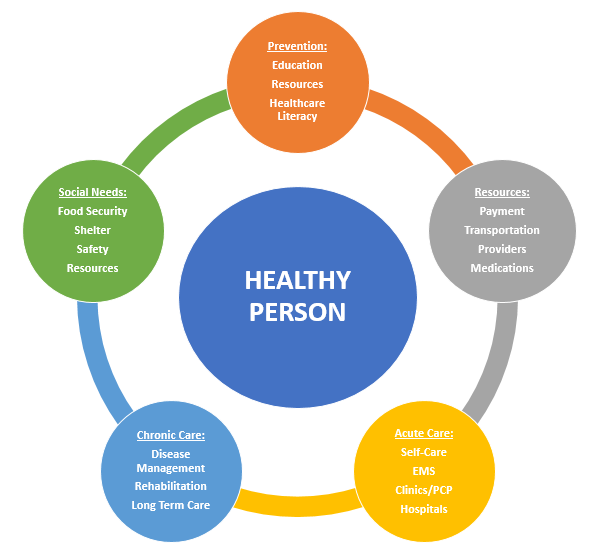
What are the Social Determinants of Health and what do they have to do with Fire/EMS?

“The social determinants of health are the conditions in which people are born, grow, live, work and age…shaped by the distribution of money, power and resources at global, national and local levels “ (WHO). They are “the complex, integrated, and overlapping social structures and economic systems that are responsible for most health inequities” and health inequity is “the difference or disparity in health outcomes that is systematic, avoidable, and unjust” (CDC).

The social determinants of health include: Income and social status, Employment and working conditions, Education and literacy, Childhood experiences, Physical environments, Social supports and coping skills, Healthy behaviors, Access to health services, Biology and genetic endowment, Gender, and Culture (Canada).

Years ago, already a paramedic, I went back to school to get my nursing degree. One of my favorite classes was on Cultural Competency. The curriculum covered the importance of understanding your patient as a complete being and recognizing how each aspect of their person had an impact on their health.

Humans are not made of molds. The complexity of our lives results in diversity, even between twins. We are a product of our complete existence and to properly understand and address health concerns, one must consider this. A couple examples…

Many people do not fill prescriptions. This is due to a variety of reasons: limited understanding of the need and purpose, limitations in insurance coverage or ability to pay, limitations in transportation resources to go to the pharmacy. Due to cost, sometimes patients are left to choose between food or housing and prescription medications. Simply prescribing medications, while it may be what the patient ultimately needs to address their ailments or manage their disease, is ineffective if their housing and food insecurities are not addressed.  

Different cultures eat differently. Managing diabetes requires the patient to be informed and deliberate about their food choices. Most of the educational materials I have seen are not culturally sensitive, meaning they are not specific to the patient or their culture and therefore fail to provide realistic and applicable information regarding which foods to avoid and which to consume more frequently for improved health outcomes.

What does this have to do with Fire/EMS? Fire/EMS and their first responder employees have a unique experience and understanding of their communities due the nature of their business, responding to those in need. With that experience, and associated information, comes responsibility. We are stewards of the people we serve. We are the safety net of society. We must leverage our data to address gaps in services and then use it to make a difference in patient outcomes either through programming and/or advocacy.

Compassionate care. Informed practice. Patience with patients. Outcome focused programming. Advocacy for change. How do the social determinants of health impact your care?

Mobile Integrated Healthcare (MIH) in the Fire Service

In one of my previous blogs, I talk about how the fire service has done an excellent job of reducing the number of fires in their communities through the efforts of their fire investigators, inspectors, and prevention personnel and programming; collectively called, Fire Prevention. Considering that 90% or more of the calls for service each year for most fire agencies are not fire in nature, but instead a combination of emergency medical and public assist calls, isn’t it time we establish something like an Emergency Medical Services (EMS) Prevention Division? Humor me and read on:

EMS Investigations: a team of highly-trained, specifically-certified people dedicated to investigating why a particular person or facility or neighborhood is having a particular set of problems such as: respiratory illness, frequent falling, medication errors, transportation barriers, lack of housing or food security. This team compiles their information into a meaningful report and passes the information onto the rest of the team for further action. If there are facilities that are mistreating their patients, or people that are committing elderly abuse, or if there are barriers to accessing primary care or housing or food or transportation, these issues would be well documented, empowering effective advocacy and accountability through the various channels for correction.

EMS Prevention: a team of highly-trained, specifically-certified people dedicated to preventing illness and injury in our communities armed with data from first response documentation and the EMS Investigations reports. They would provide targeted education and training to the community, such as: how to prevent diabetes, heart disease, strokes, drownings, falls, vehicle accidents, and more. Rather than fire exit drills they would be providing healthy diet, exercise, and rest modules. Rather than teaching CPR at local pools, they would be mandating and facilitating the installation of pool gates and safety alarms to prevent drowning in the first place. They would be testifying before the legislature regarding unsafe practices in nursing homes and assisted living facilities, ensuring patients receive the care and attention they deserve. They would advocate for a more comprehensive public transportation model that didn’t require 2-hours and 8 bus changes to get somebody to their job, each way. They would advocate for affordable housing and against food deserts and lack of primary care.

EMS Inspectors: a team of highly-trained, specifically-certified people dedicated to ensuring neighborhoods, apartment complexes, medical facilities, nursing homes, assisted living facilities, and schools are following the best practices identified through the EMS Investigations findings…that people are safe from medication errors, fall risks, and healthcare and social service practices more interested in profits than patient outcomes. Just as Fire Inspectors have the authority to assess fines and close unsafe buildings, EMS Inspectors could be so empowered.

This is Mobile Integrated Healthcare (MIH) in Fire Services. MIH is simply using patient-centered, mobile resources in the out-of-hospital setting for improved community outcomes. The Fire Service is well-positioned to provide these services for three main reasons: 1. publicly funded services have an obligation to do the right thing regardless of reimbursement or financial profits; 2. preventing illness and injury in the community is the right thing to do; 3. if you do nothing, it’s only going to get worse and our current models can’t support that.

What are your thoughts about an EMS Prevention Division a.k.a. Mobile Integrated Healthcare in the Fire Service? Leave your comments below:

When you’re so good that you risk becoming obsolete

It comes as no surprise to most people that fire departments are expensive to operate. Considering the fire stations, fire apparatus, tools, equipment, and manpower it requires to provide a service in which you make a phone call and in less than ten minutes you have an arsenal of highly-trained, terrifically-equipped people at your location ready to lay their lives on the line to make sure you’re ok, it makes sense.

True, there aren’t as many fires as there once was, but that is no accident. You see, we care so much about you and recognize that the best way to keep you safe is to prevent the fire from happening in the first place. So, we have fire investigators that determine what caused the fire. If it was an arsonist, we arrest them. If it was a curious child, we help them understand the dangers of playing with fire. If it was faulty electrical or poor building design, we change building codes so it won’t happen again. It’s an interesting business model, I know.  

It comes as a surprise to many people that firefighters do much more than fight fire. The fire department has become your all-hazards, jack-of-all-trades, first response agency that “puts out fires” of all shapes and sizes, both literally and metaphorically. House fire? We got you. Trapped in your car, need to be extricated? Yup, that too. Stuck in an elevator? We’re coming. Choking, drowning, or suffering from a stroke? We know what to do. Delivering a baby? Let me grab that bag.

The reality is that occasionally things are going to catch fire and we need to be ready to put them out. Rather than just sitting here waiting for a fire, we have found other ways to provide value to our community through fire prevention, fire investigations, fire inspections, emergency medical services, vehicle extrication, and more.

When you’re so good that you risk becoming obsolete, you build on your model and find ways to deliver even more value to your customer.