
Courage in Innovation

We have a new program in our fire service, the Nurse Call Line. The Nurse Call Line exists to better navigate our community through the health and social service agencies of our community.

Without it, when people call 9-1-1, they are dispatched an ambulance, or more, maybe a fire truck or engine, depending on their complaints. Upon arrival, the EMS providers are straddled with two options: one, transport the caller to the hospital by ambulance; or two, the caller refuses medical treatment and transport. There is currently no in-between.

With the Nurse Call Line, we are able to connect 9-1-1 callers that have low acuity complaints directly with an emergency-medicine-experienced, registered nurse that utilizes a set of evidence-based, time-tested protocols and determines alternate care plans such as self-care, self-transport, the dispatching of emergent or non-emergent EMS resources, or maybe even a ride-sharing service.

Every time the Nurse Call Line doesn’t send an EMS resource, they save the callers, the insurance companies, and the community hundreds of dollars by reducing unnecessary EMS transports to the hospital. Every time the Nurse Call Line is able to address the needs of the caller without transportation to a health care facility and instead manages the needs of the caller through referrals to alternative resources or provides them with information for self-care, they save even hundreds more in prevented urgent care and/or emergency department costs.

Bottom line, the Nurse Call Line saves money and aligns callers with the most appropriate care for their needs.

We started the Nurse Call Line two years ago as a pilot program, wishing to evaluate the results before committing to permanent staff and funding. Two years ago, we recruited a team of nurses that were highly skilled and experienced in emergency medicine. We shared with them our dream, the intent of the program, the molds we were going to break, the uncertainty of the program’s future and invited them to join us on the journey. Each nurse that was offered the position accepted, despite this uncertainty and lack of sustainability. Each of the nurses that joined our team knew exactly what we were trying to accomplish, because they, as emergency medical nurses, had been experiencing the same frustrations we had. They also understood that the system was broken and that this new way of connecting with patients had great potential.

Hundreds of years ago, when captains recruited crew members for sailing exhibitions, they promised gold and riches, freedom and glory. This is what inspired men to travel into the great unknown, for near-certain death. Countless brave and courageous men lay at the bottom of the ocean, having lost the battle somewhere at sea and hundreds of miles from their intended shore and land of opportunity. Our nurses have that courage.

Like all new programs, there are many unknowns. Like all new programs, we deliberated about the details and pontificated over the possibilities, but at some point, we had to launch. We expected much learning along the way, discovery in the journey, and we knew we would never reach our final destination as there will always be more opportunity or room for growth and expansion.

The Nurse Call Line was no different. We made many mistakes, especially along the lines of training both new and incumbent staff. We could have done better, especially as it pertained to existing employee buy-in and engagement. We did our best at the time, especially when it came to the IT programming and interface…we were building a plane in-flight and these were unchartered lands.

Fortunately, we had a great crew. They knew where we were heading and what we were trying to accomplish. They forgave and instead supported the weaknesses of their leaders, while displaying courage and commitment in the face of opposition and uncertainty. And while we have not crossed the finish line, we have made progress and have confidence we are heading in the right direction.

It takes courage to be innovative. I am grateful for the courage the nurses of our pilot program have demonstrated over these past two years! Their bleeding hearts of compassion are those of warriors.
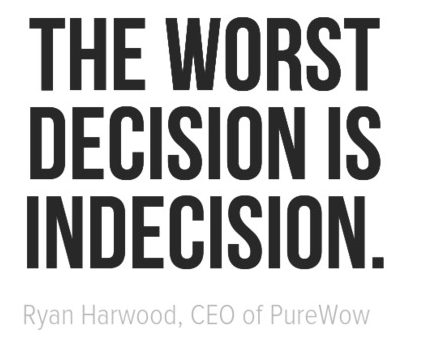

The Decision of Indecision

I’ve never really been one for indecisiveness and not because I always know what to do or have the right answer. Instead, my choice to make a decision stems from an understanding that not making a decision is a decision and likely the option I have less control over. I found the following quote from Bill W. that sums it up nicely, “Indecision with the passing of time becomes decision”.

Being decisive is a multifaceted state. You’re faced with a decision. You consider the facts, the outcomes, the consequences. You choose. Life goes on. It has been my experience that opportunities to make decisions never stop coming. They’re not like the items on my Monday To-Do List, whereas once I cross it off it is done, gone, I don’t have to worry about it anymore. Opportunities to make decisions keep coming, and they aren’t going to stop. It takes confidence to make decisions, and making decisions builds confidence. Sometimes, it might even take courage to make a decision.

Some decisions are significant and come with great consequences. They require time and patience: time to work through the problem to find the Simplicity on the Far Side of Complexity, and patience to allow facts to surface and conclusions to formulate. Often though, especially with significant decision-making moments, there will be several smaller decisions to be made after the fact, providing ample opportunity to make subtle corrections if needed or to address certain aspects not directly impacted by the initial decision. Overthinking the situation can lead to Paralysis by Analysis, or indecision.

Yes, making a decision can be scary or worrisome. Nobody likes to be wrong or make bad decisions. But like Maimonides said in his quote, “The risk of a wrong decision is preferable to the terror of indecision”, or Aaron Burr in his, “Error often is to be preferred to indecision”, indecision is even worse than being wrong. Even Berhard Langer agrees, “Be decisive. A wrong decision is generally less disastrous than indecision”.

After all, like John Ortberg said, “Greatness is never achieved through indecision”. Be great, start by making a decision!

Seize the moment, it’s the catalyst of your future

Several years ago, one of my mentors wisely said, “every day and every moment is a job interview, you never know who is watching and what they might mean to you now and in the future”. I have often repeated these words to myself throughout the course my life and career, and more times than I can count, they have proven to be true. One time in particular that comes to mind was when I was testifying before a government council on behavioral health, providing both subject matter expertise regarding a policy change they were considering as well as presenting a potential program to better address mental health crisis and associated emergency response. That moment provided one opportunity within weeks and another several years later.

The first opportunity was immediate recruitment to join the working group tasked with getting community paramedicine from concept to bill to state law. After several months, meetings, trips to the state capitol, and more testifying before the legislature, we were successful! Many members of the working group have gone onto other related adventures and projects. Some remain in their previous positions or companies, continuing to be innovative and changing the way we provide care and services to our communities. All of them are influencers and amazing people to know. I am grateful for the lasting relationships the working group involvement afforded me.

The second opportunity was nearly three years after testifying before the government council. A member of the audience remembered the presentation on the program to better address mental health crisis and associated emergency response and wanted to provide state funding to try it. It came as a complete surprise but we were eager to give it a whirl and ultimately, the program is getting even-better-than-expected results! We call it the Crisis Response Team. A public-private partnership with the state, local fire department, private ambulance, and a nonprofit working together to provide an ambulance response with an advanced EMT, paramedic, and licensed clinical social worker to behavioral health crisis calls within the emergency response system.

And so those words of my mentor continue to repeat in my head frequently, even in the most seemingly insignificant of circumstances. Every day, we come in contact with more people than we realize. How do we portray ourselves? What do we communicate to them through our words and actions about our values, purpose, and potential? If we were to treat each project, each conversation, each encounter as if it were an interview for the future job of our dreams, how would that influence our effort and behavior?