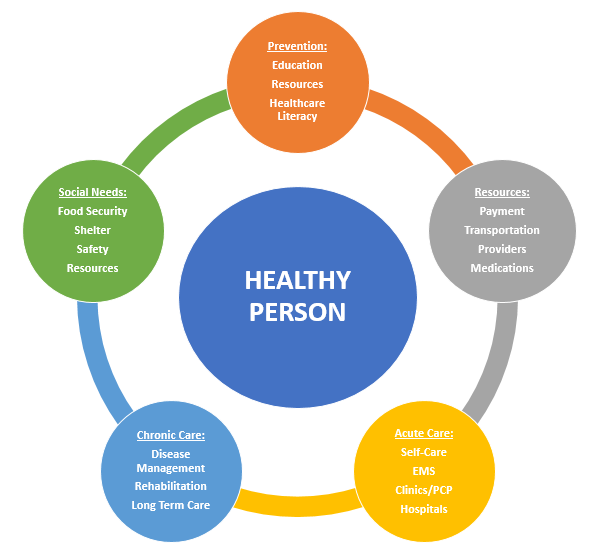
What are the Social Determinants of Health and what do they have to do with Fire/EMS?

“The social determinants of health are the conditions in which people are born, grow, live, work and age…shaped by the distribution of money, power and resources at global, national and local levels “ (WHO). They are “the complex, integrated, and overlapping social structures and economic systems that are responsible for most health inequities” and health inequity is “the difference or disparity in health outcomes that is systematic, avoidable, and unjust” (CDC).

The social determinants of health include: Income and social status, Employment and working conditions, Education and literacy, Childhood experiences, Physical environments, Social supports and coping skills, Healthy behaviors, Access to health services, Biology and genetic endowment, Gender, and Culture (Canada).

Years ago, already a paramedic, I went back to school to get my nursing degree. One of my favorite classes was on Cultural Competency. The curriculum covered the importance of understanding your patient as a complete being and recognizing how each aspect of their person had an impact on their health.

Humans are not made of molds. The complexity of our lives results in diversity, even between twins. We are a product of our complete existence and to properly understand and address health concerns, one must consider this. A couple examples…

Many people do not fill prescriptions. This is due to a variety of reasons: limited understanding of the need and purpose, limitations in insurance coverage or ability to pay, limitations in transportation resources to go to the pharmacy. Due to cost, sometimes patients are left to choose between food or housing and prescription medications. Simply prescribing medications, while it may be what the patient ultimately needs to address their ailments or manage their disease, is ineffective if their housing and food insecurities are not addressed.  

Different cultures eat differently. Managing diabetes requires the patient to be informed and deliberate about their food choices. Most of the educational materials I have seen are not culturally sensitive, meaning they are not specific to the patient or their culture and therefore fail to provide realistic and applicable information regarding which foods to avoid and which to consume more frequently for improved health outcomes.

What does this have to do with Fire/EMS? Fire/EMS and their first responder employees have a unique experience and understanding of their communities due the nature of their business, responding to those in need. With that experience, and associated information, comes responsibility. We are stewards of the people we serve. We are the safety net of society. We must leverage our data to address gaps in services and then use it to make a difference in patient outcomes either through programming and/or advocacy.

Compassionate care. Informed practice. Patience with patients. Outcome focused programming. Advocacy for change. How do the social determinants of health impact your care?
Healthcare, right or privilege?

I know, this can be a touchy subject and I am not going to pretend to have the answer, but I believe it is important that we have this conversation as we work through the issues currently facing healthcare in the United States. I also am not going to pretend to be an expert, certainly not on healthcare entirely, but I do have some experience, especially in emergency medical services.

Most people are unaware and uninformed of the experiences of emergency medical services providers. Most assume they are filled with cardiac arrests, severe respiratory distress, critical trauma, heart attacks, strokes, and other “true” emergencies and while this is partially correct, would it surprise you to learn that a significant portion of 911 calls for service are not necessarily “true” emergencies, but instead people that lack resources such as housing, food, transportation, prescription refill, behavioral health, or primary care? People routinely utilize the 911 system for: a hot meal and a bed for the night; the ambulance ride to the hospital because they don’t have their own car, a family member or friend that can take them, or money for a cab or public transit; prescription refill because they have run out of their medication and they can’t get into their primary care physician (if they even have one) for several weeks; and, their limited behavioral health benefits have run out (if they had them at all). Sometimes, they call 911 because they assume if they arrive by ambulance, they won’t have to wait in the emergency department waiting room.

I bring this up in the context of the question of healthcare being a right or privilege because from an emergency medical services perspective, due to EMTALA (and basic principles of humanity), access to emergency healthcare is a right. Emergency medical providers must treat all who call upon their services without prejudice, whether or not they are insured or have the ability to pay. In most communities, EMS protocols don’t allow them to transport the patient anywhere but the hospital and they seldom, if ever, permit EMTs and paramedics to treat and release. This means that most people that call 911, whether they are having an emergency or not, whether they can pay or not, are going to the hospital by ambulance.

What we know about healthcare is that emergency is the most expensive form of services. Primary and preventative care is significantly less expensive and if used, greatly improves health outcomes and thereby reduces morbidity and complications. If we treat services such as primary care, preventative care, dental care, behavioral health, eye care, pain management, nutrition, chronic disease management, and programs that address the social determinants of health as a privilege, we all pay for the over-utilization of emergency medical services for two reasons. One, people will be sicker because they don’t have access to primary and preventative care thereby utilizing emergency services in their place or waiting until they are so sick, they actually experience an emergency. Two, all services will be more expensive because somebody has to pay the bill. Nothing is free.

The cost of doing nothing is exorbitant. Untreated behavioral health results in greater crime rates, jail and law enforcement costs, increases in drug and alcohol abuse, homelessness, and more. Not addressing social determinants of health such as housing, food, transportation, nutrition, and education results in poorer health, an increase in medical costs, lost productivity, and more. Not only is refusing access to quality human services due to a lack of ability to pay inhumane, it is fiscally irresponsible. What are your thoughts? If it isn’t a right and it is a privilege, when do we say “no” and how?